BORSTRECONSTRUCTIE
Lumbar flap
Borstreconstructie Borstreconstructie met eigen weefsel Lumbar flap
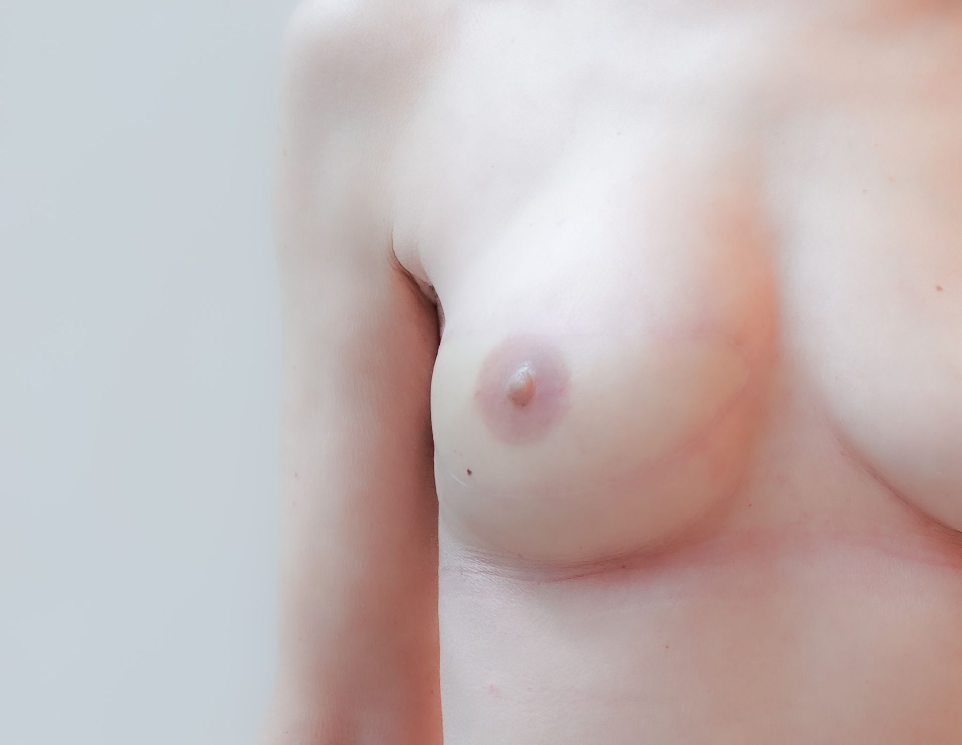
Lumbar flap.
De lumbar flap is een alternatief voor een DIEP flap. Deze flap bestaat uit huid- en vetweefsel verwijderd uit de lage rugregio, net boven de heupkam.
Technically, the lumbar flap is somewhat more difficult and requires expertise in microsurgery. Our department is a pioneer in the field of the lumbar flap with years of experience with this technique.
Indications.
Insufficient abdominal tissue.
Patients who are thin and have little fat tissue in the abdominal region are not eligible for a DIEP flap procedure. They often are eligible for a lumbar flap. Also, patients with poor blood vessels in the abdomen, making a DIEP impossible, may be candidates for a LAP flap.
Scars in the abdominal area.
Patiënten die eerder een buikoperatie hebben ondergaan en daardoor niet geschikt zijn voor een DIEP flap, kunnen in plaats daarvan een lumbar flap overwegen. Onder buikingrepen worden verstaan buikwandcorrecties, liposucties of andere ingrijpende ingrepen met littekens ter hoogte van de buik.
Previous flap surgery
Patiënten die eerder een borstreconstructie hebben ondergaan aan één borst en nu een reconstructie van de andere borst nodig hebben, kunnen mogelijk in aanmerking komen voor een lumbar flap.
Lumbar flap
The lumbar flap is a nice alternative when a DIEP flap is not possible. The procedure is technically somewhat more difficult and requires experience in microsurgery.
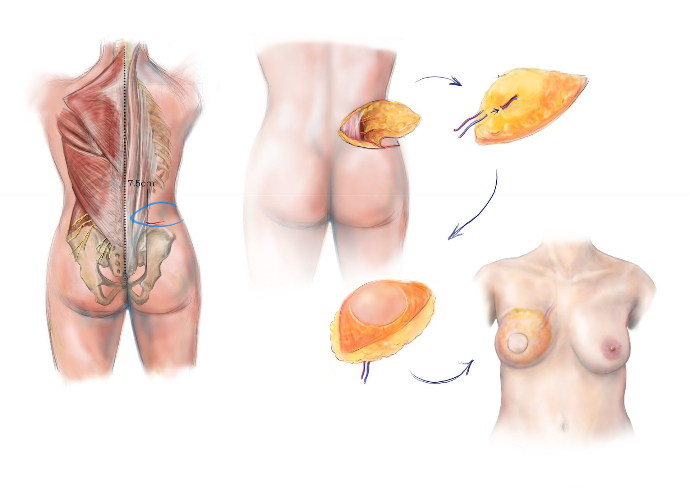
Course of lumbar flap (LAP flap).
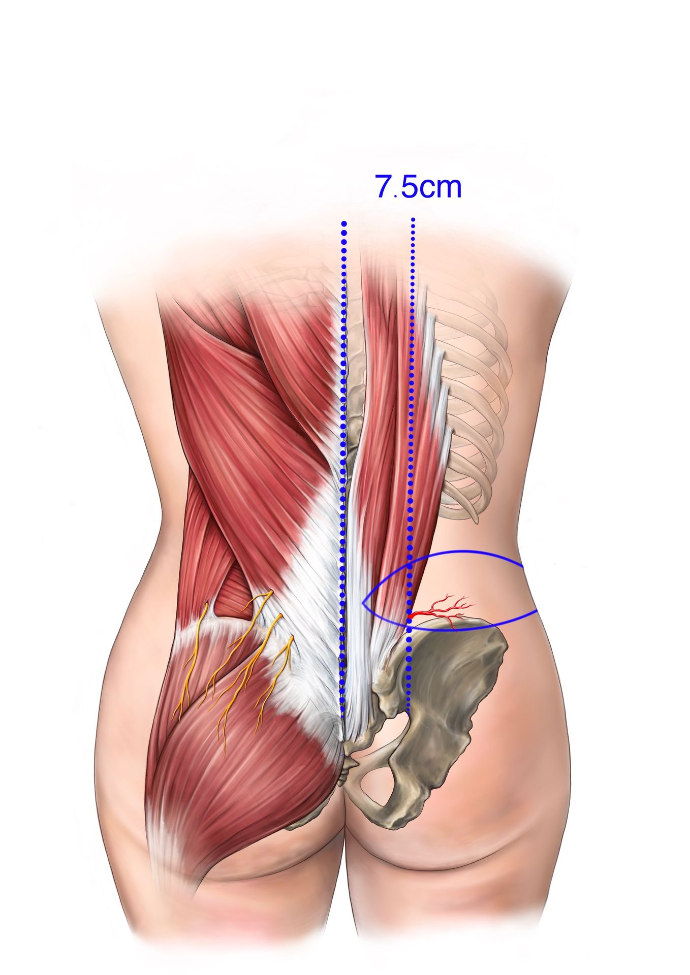
The lumbar flap consists of skin and fat tissue removed from the lower back region just above the iliac crest. Sensory nerves in that region can be taken to restore sensation in the breast.
The subcutaneous fat tissue in this region is soft and of good quality for reconstructing a breast. The short blood vessel that supplies the lumbar flap with blood runs between the muscles and is accompanied by a long sensory nerve. The back muscles therefore remain nicely intact after the removal of the lumbar flap.
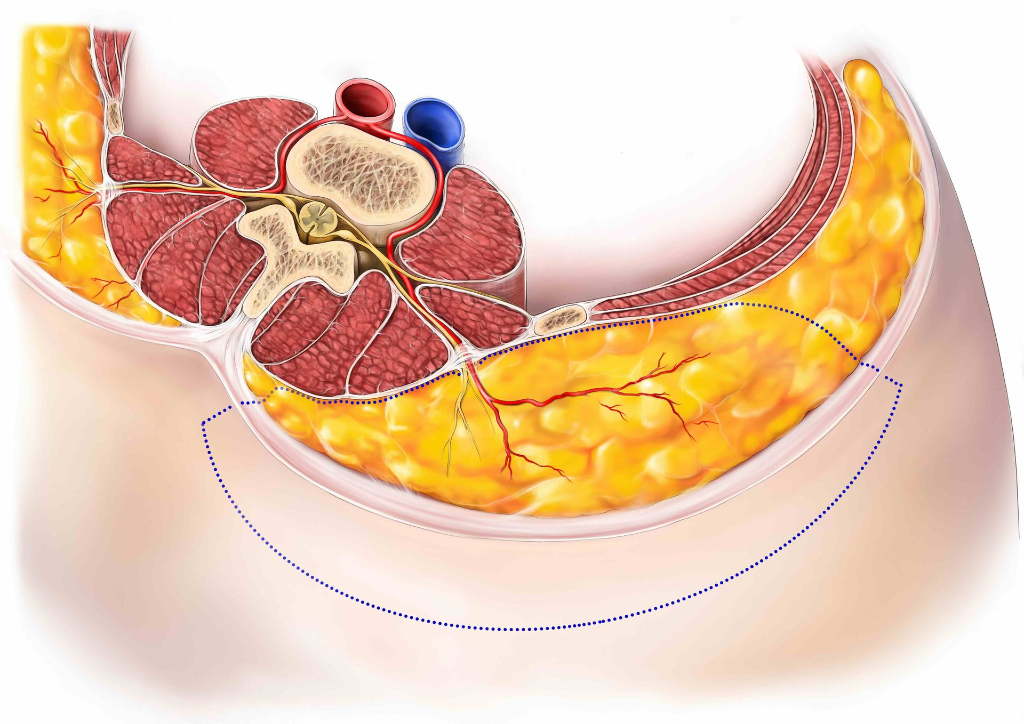
Vessel graft.
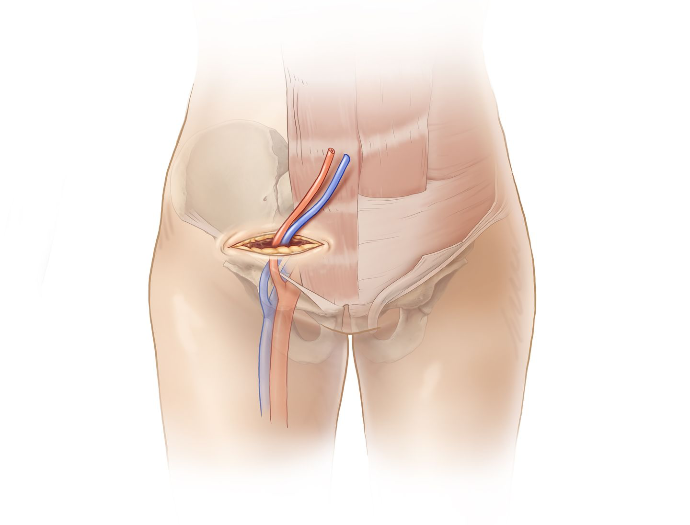
Because the blood vessel of the lumbar flap is short (2 to 3 cm), it must be extended to make the procedure technically easier. An extra piece of blood vessel is taken from the groin area. This is called a vessel graft or vessel graft. The length of this graft is on average 6 to 7 cm.
Positioning.
During the procedure, the patient must be turned. We start in a supine position (taking the vessel graft and preparing the chest) and then turn to a prone position to remove the lumbar flap. After closing the wound, the patient is turned back to a supine position to perform the reconstruction. Therefore, a lumbar flap takes a bit longer; on average 7 to 8 hours.
Microsurgery.
After the lumbar flap is removed, it is placed on a sterile table. There, the vessel graft is sutured to the short blood vessel of the lumbar flap. This is done using an operating microscope and microsurgical techniques due to the small diameter of the blood vessels.
LAP flap inset.
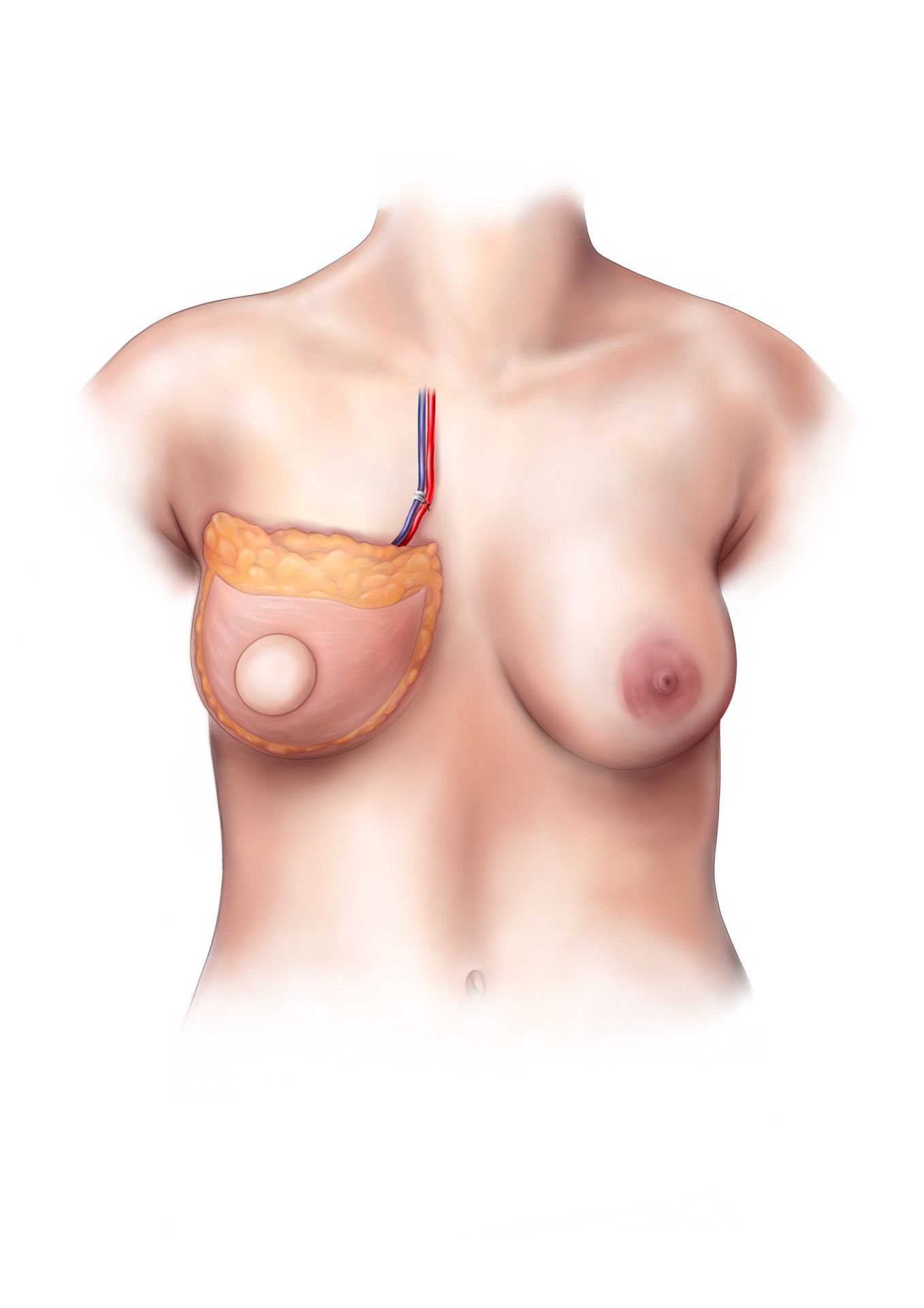
Once the vessel graft is connected to the blood vessel of the lumbar flap, everything can be moved to the chest, where the blood supply will be restored (also with microsurgery). In this way, the new breast is reconstructed.
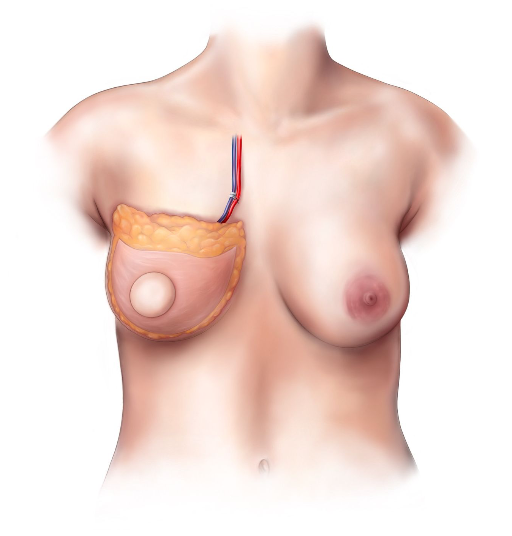
Modeling the lumbar flap
One advantage of the lumbar flap is that the shape of the new breast is immediately optimal. As a result, fewer adjustments are often needed afterwards. These adjustments take place about six months later after the breast has become nicely soft. The goal is to achieve good symmetry between both breasts.
Frequently asked questions
The lumbar flap is technically somewhat more difficult than, for example, the DIEP flap because the blood vessels are small and short. The risk of flap failure is also higher than with the DIEP flap and is estimated to be around 3 to 5%. This is mainly related to the expertise of the surgeon but also to additional risk factors such as: low blood pressure, clotting problems, or obesity. One also experiences a numbness sensation in the lower back at the site where the tissue was removed. This can partially recover, but a small area around the scar may remain numb. Immediately after the procedure, one will also be sensitive to the formation of a seroma at the site where the tissue was removed. A seroma is a collection of wound fluid. This is resolved by puncturing and removing this seroma during the consultation.
One of the advantages of the lumbar flap is the beautiful shape of the breast; sometimes better than a DIEP flap. The breast has an immediate nice projection, soft transitions with the chest wall, and a full lower pole.
An additional advantage of the lumbar flap is that one can perform a restoration of the innervation, allowing the new breast to regain sensation. This is because there are long nerve endings present in the lumbar flap that can easily be connected to the sensory nerves at the level of the chest wall.